
Search Delaware Police Records
Delaware police records are public safety documents held by state troopers, county sheriffs, and city police departments across the state. Anyone can look for Delaware police records through the Freedom of Information Act or go right to the agency that made the report. You can search incident reports, arrest records, crash reports, and sex offender listings. The Delaware State Police, the State Bureau of Identification, and local police all keep their own sets of files. Some records are open to the public. Others have limits set by law. This page walks you through the main ways to find and request Delaware police records.
Delaware Police Records Overview
How to Search Delaware Police Records
You can search Delaware police records in a few ways. The fastest path is to go right to the agency that made the report. The Delaware State Police, city police, and county sheriffs each keep their own files. For a full incident report or a crash report, ask the agency that worked the case.
For criminal history data, the State Bureau of Identification holds the state record. For court data like arrests, charges, and sentencing, the Delaware Courts system is the place to look. The Delaware Public Archives holds old records that have passed their retention date. Delaware's Freedom of Information Act, found at 29 Del. C. §§ 10001 to 10008, sets the rules for how to ask for and get records from any public body.
You can file a written request by mail, by email, or through an online portal. The agency has 15 business days to reply. The first 20 pages are free. After that, each page is ten cents. Some police files, such as open case notes and intel files, are not open to the public.
Delaware State Police Records Division
The Delaware State Police is the lead law enforcement agency in the state. The DSP keeps records for crashes, arrests, calls for service, and criminal cases worked by troopers. The DSP FOIA Coordinator is Angie von Bank at angie.vonbank@delaware.gov. The physical address for FOIA requests is 1441 N. DuPont Highway, Dover, DE 19901.
You can file a FOIA request online or by mail. The DSP has a web form and a printable PDF. The agency has 15 business days to reply under state law. Not every file is released. Under 29 Del. C. § 10002(o)(3), open case files and intel files are exempt. Attorney General Opinion No. 25-IB29 upheld the DSP in its denial of body-worn camera footage for an active case.
The DSP has more than a dozen troops spread across Delaware. Each troop keeps its own files. When you ask for a report, it helps to know which troop worked the case, or at least the town or road where the event took place.
The DSP page below lays out the full FOIA process, staff contacts, and forms. It is the first stop for most state-level Delaware police records.
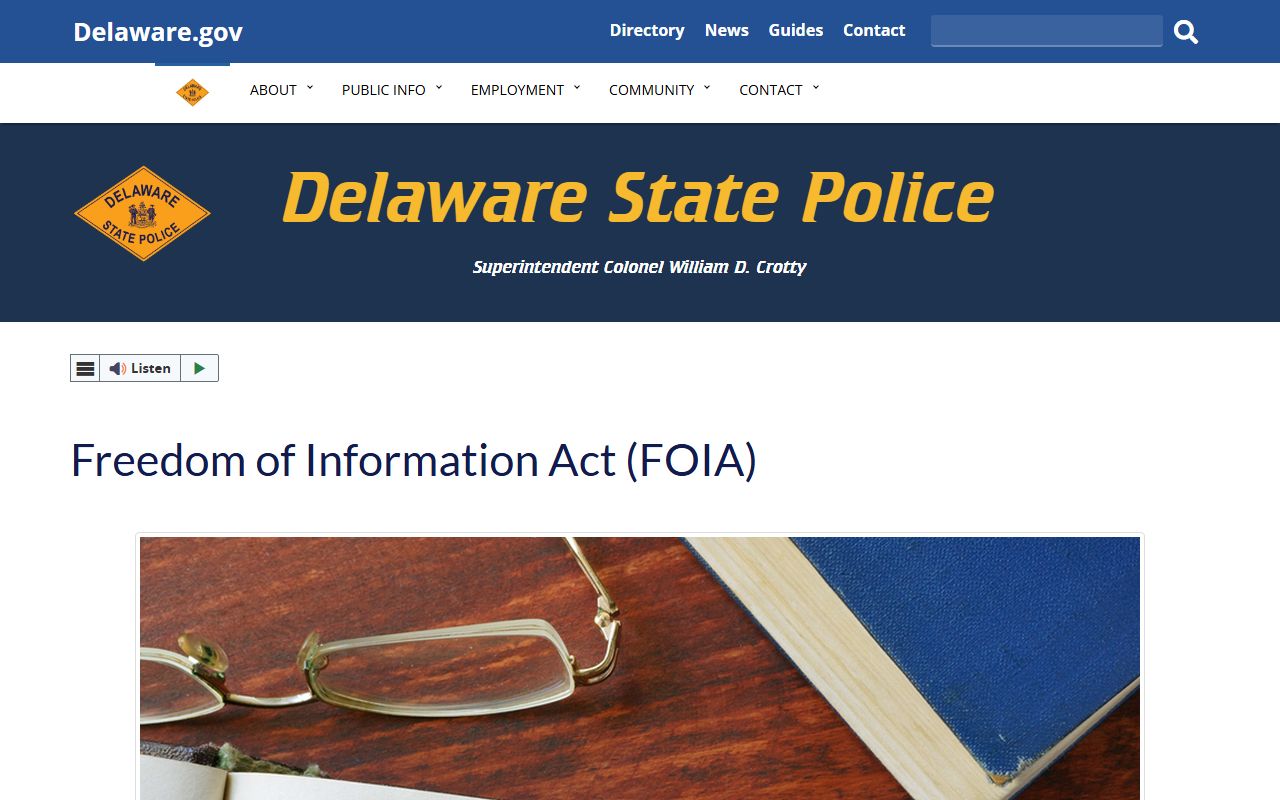
The DSP portal lists the coordinator's email, the mailing address, and the online form. It also spells out what kinds of Delaware police records the DSP is likely to release and what kinds fall under a statute bar.
State Bureau of Identification Services
The State Bureau of Identification is the central hub for Delaware criminal history records. The SBI does fingerprint background checks for people who want their own record. The SBI also runs the Delaware Sex Offender Central Registry, which is updated every Friday.
There are three SBI offices. The Kent County office sits at 600 South Bay Road, Suite 1, Dover. The New Castle County office is at Delaware State Police Troop 2 on Route 40 in Bear. The Sussex County office is at the Thurman Adams State Service Center, 546 S. Bedford Street, Room 202, Georgetown. Kent offers walk-in service. Sussex and New Castle require an appointment. Call (302) 739-2528 to book a slot.
The SBI fee for a state background check is $52.50. A state and federal check is $69.00. Pay with cash, a credit card, a bank check, a money order, or a company check. The SBI does not take personal checks. Bring a photo ID such as a driver's license or a state ID.
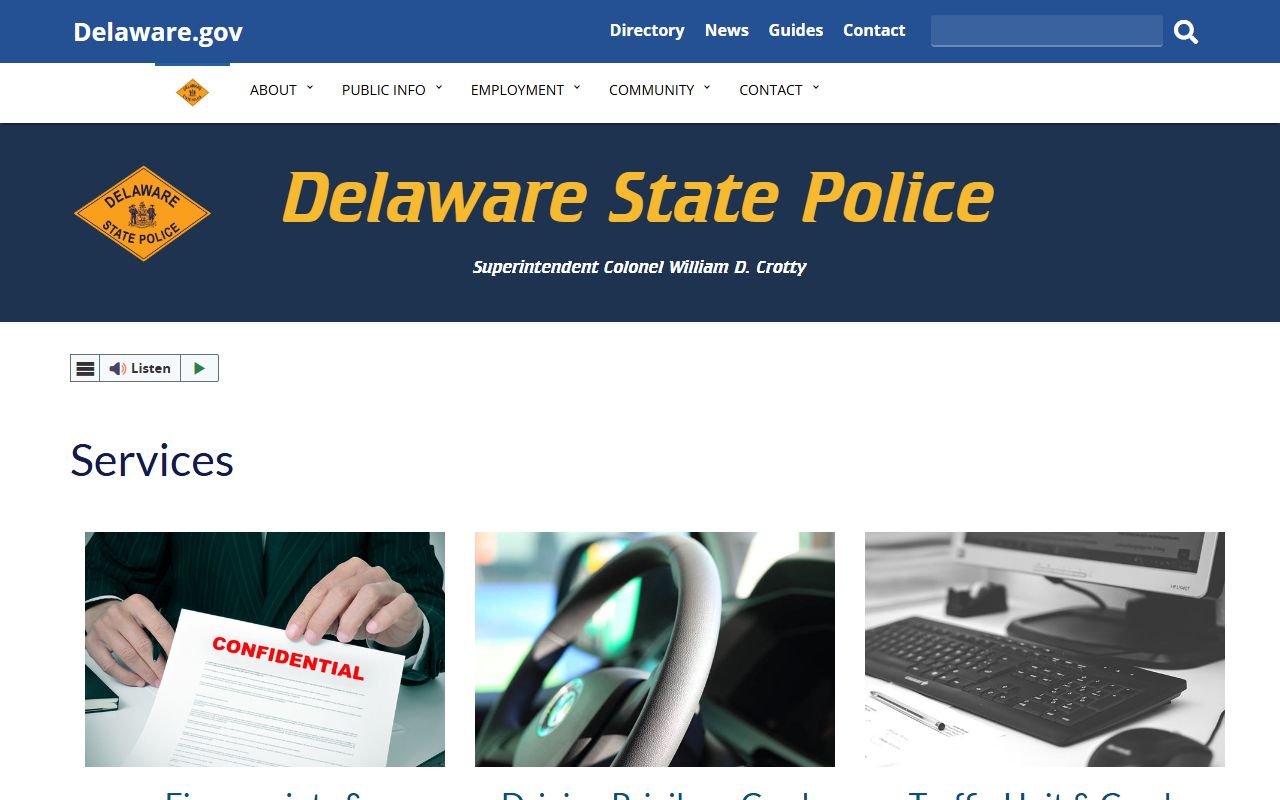
The services page lists SBI office hours, fees, and the kinds of checks the unit does. It also has notes on crash reports and driving privilege cards handled by the same DSP staff.
Delaware Freedom of Information Act
Delaware adopted its FOIA in 1977. The law lives at 29 Del. C. Chapter 100. Section 10001 sets the findings. Section 10002 lists the 19 exempt categories. Section 10003 opens all public records to inspection and copying during regular hours.
A "public record" is any file or data held by a public body that deals with public business. That includes many Delaware police records, such as crash logs, arrest logs, press releases, and policy manuals. It does not cover open case files, intel files, personal privacy data, or sealed criminal files. Under § 10002(o)(3), investigatory files tied to a criminal case are out of reach.
The law gives a public body 15 business days to reply. The reply must grant access, deny access and cite a statute, or ask for more time. The first 20 pages are free. Each page after that is ten cents. Staff may also charge for the time it takes to pull the file, billed at the rate of the lowest-paid worker who can do the task.
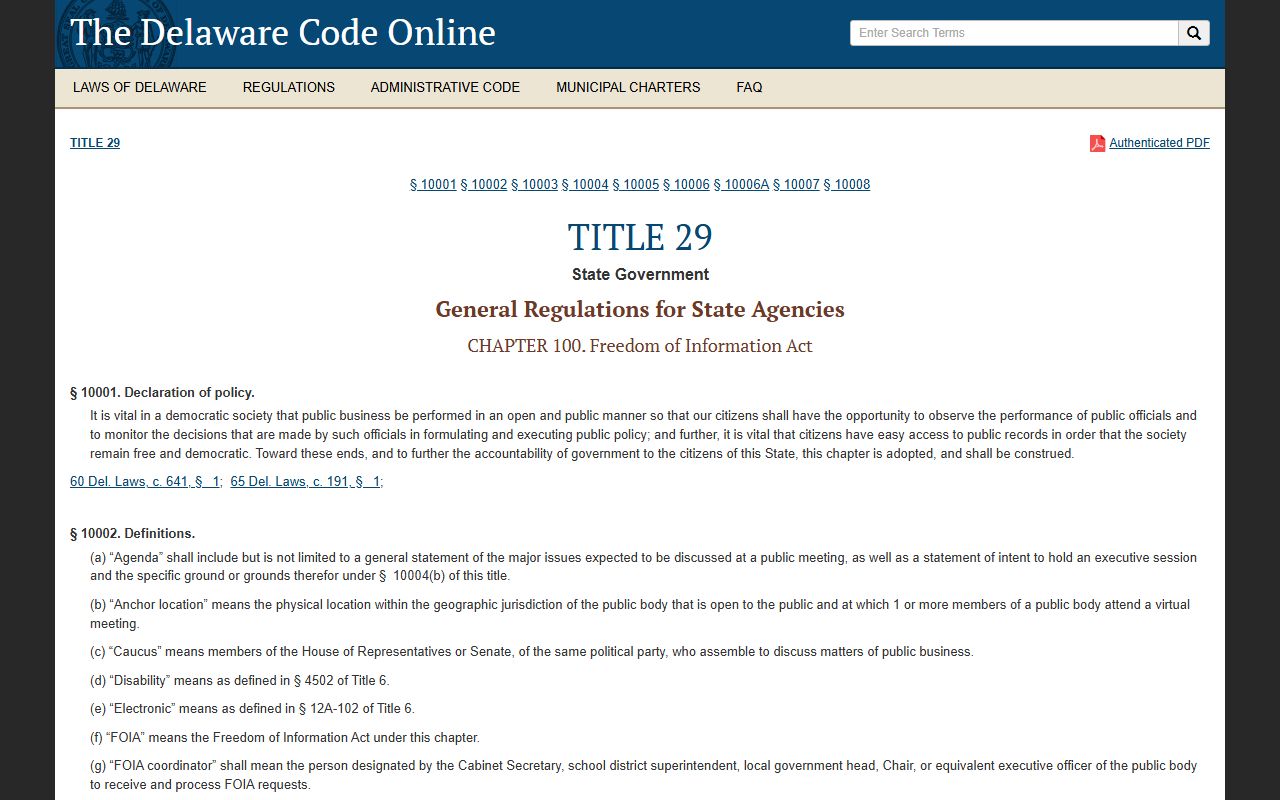
The code site holds the full text of the FOIA statute. You can read each section and the full list of exempt file types. It is the most reliable source for the law that governs Delaware police records.
Delaware also runs a single FOIA portal. It lists every state agency that takes a FOIA request. You can file with the DSP, the Department of Safety and Homeland Security, the Department of Justice, or any other state body from one page. Executive Order No. 31 from 2011 set the standard policy across the executive branch.
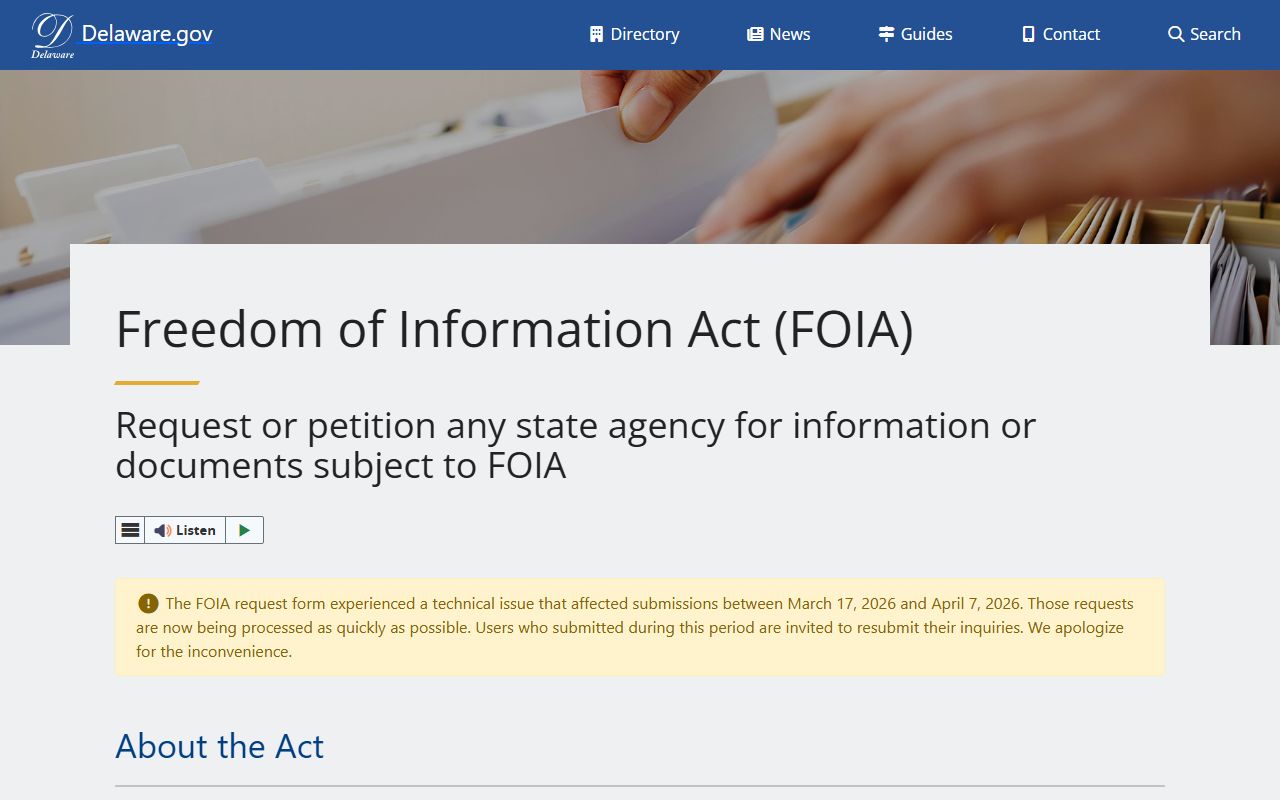
The portal has a PDF form you can print or a web form you can send online. Pick the agency, fill in the facts, and send. The page also links to each agency's FOIA contact.
Note: A FOIA request itself may be a public record under Delaware law, so anything you write in the request form can later be released to others.
Court Records and Delaware Police Records
The Delaware court system holds many records tied to police work. Courts hear arrests, criminal charges, traffic cases, and civil suits. A police report may go into a court file if the case moves forward. The state courts are the Supreme Court, the Superior Court, the Family Court, the Court of Common Pleas, and the Justice of the Peace Court.
CourtConnect is the state's public case lookup tool. You can search by name, business, or case number. The tool shows docket entries, hearings, case status, and orders. Basic lookups are free. A certified copy costs a set fee. Juvenile files, adoption files, mental health records, and sealed or expunged files are not public.
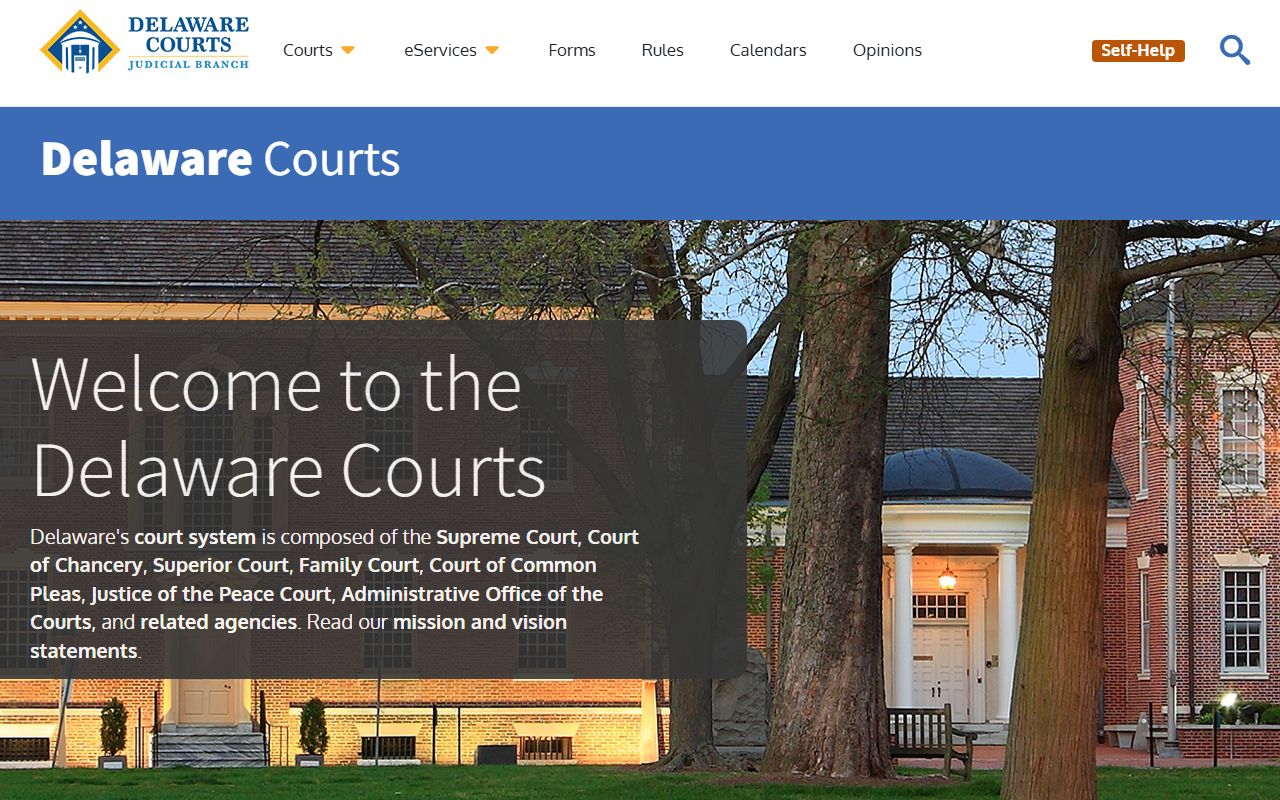
The Courts site links to CourtConnect, forms, court dates, and local clerks. The Administrative Office of the Courts runs the system, and each county has its own Superior Court clerk for felony files.
For a certified copy of your own criminal history, the request goes to the DSP State Bureau of Identification. DELJIS, the Delaware Criminal Justice Information System, holds arrest, charge, and sentencing data. DELJIS also runs the wanted persons list. Public access is limited. The SBI serves as the go-between for FBI checks under state and federal law.
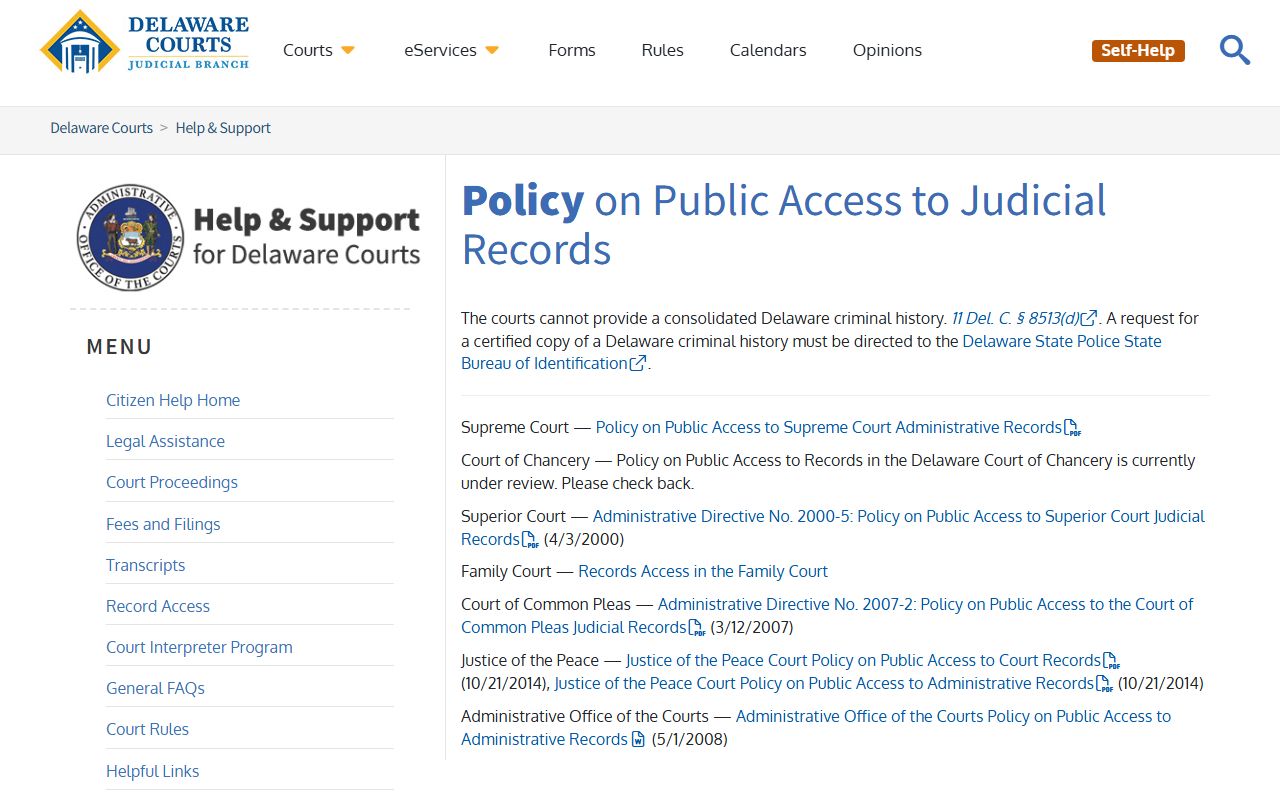
The record access page sets out what court files are public, what files are sealed, and how to get a copy. It also notes the fees and the rules for remote access.
Historical Delaware Police Records
The Delaware Public Archives holds old Delaware police records after they pass the set retention date. Under the state record retention schedule, ID files known as LGPOL-003 are kept until the subject is known dead, likely dead at age 85, or has had no activity for 30 years. Investigation files known as LGPOL-004 are kept for 100 years by the New Castle County Police, the Dover Police, and the Wilmington Police. All other local agencies keep their files for 10 years.
The Archives also holds old vital records. Birth records become public after 72 years. Marriage records open after 50 years. Death records open after 40 years. You can get a photocopy of a microfilm record for 50 cents per page. A certified copy is $25 per page. Staff can pull files in person at the Dover site.
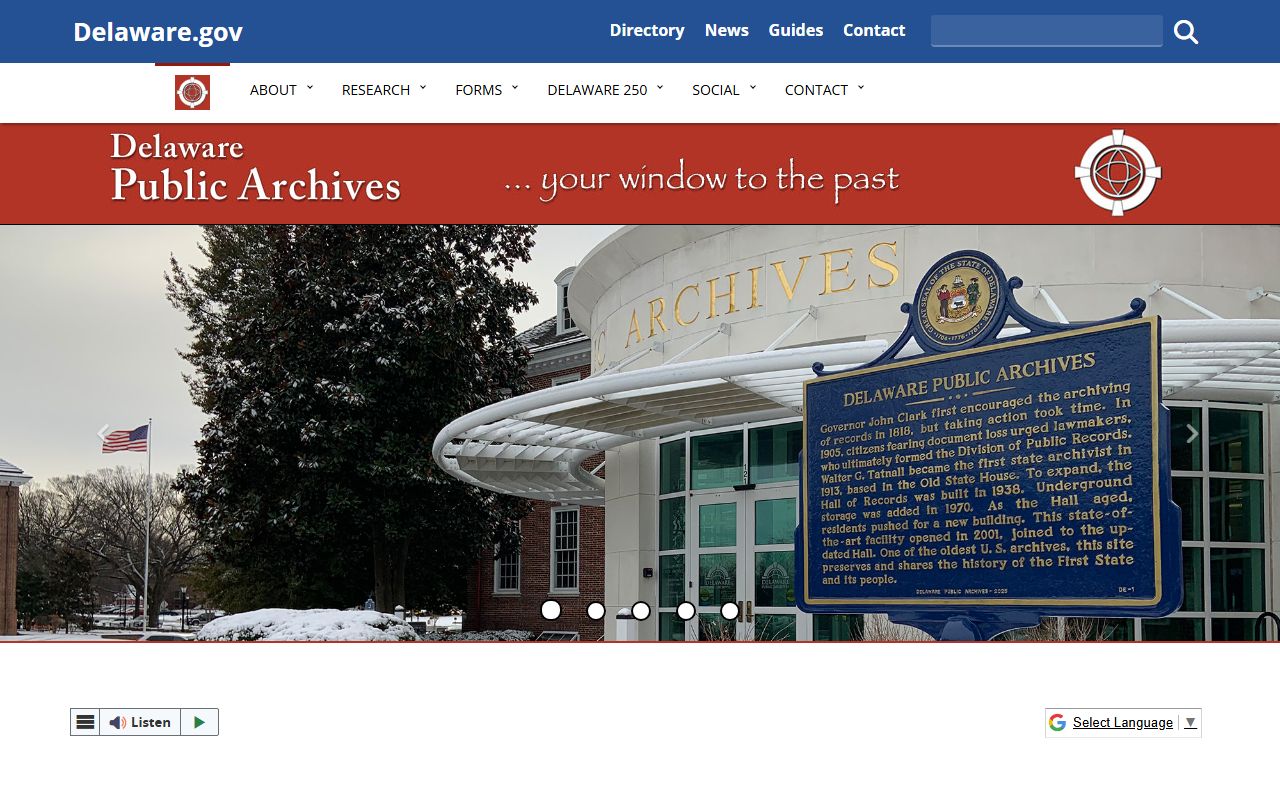
The Archives site links to the full retention schedules, the research room hours, and the copy fee list. It is the right place to find old files no longer held by a working police agency.
Attorney General and Open Government
The Delaware Department of Justice runs the open government program. Its office gives advice to public bodies, takes FOIA complaints, and issues formal opinions. The DOJ says it is vital in a free society that public business be done in the open and that citizens be able to watch the work of their public officials.
If an agency denies your FOIA request, you can file a petition with the AG. Send mail to 820 N. French St, 6th Floor, Wilmington, DE 19801. Email works too at opengovernment@delaware.gov. The AG reviews the facts, asks the agency for a reply, and issues a written opinion. You can also sue in Superior Court under § 10005(b).
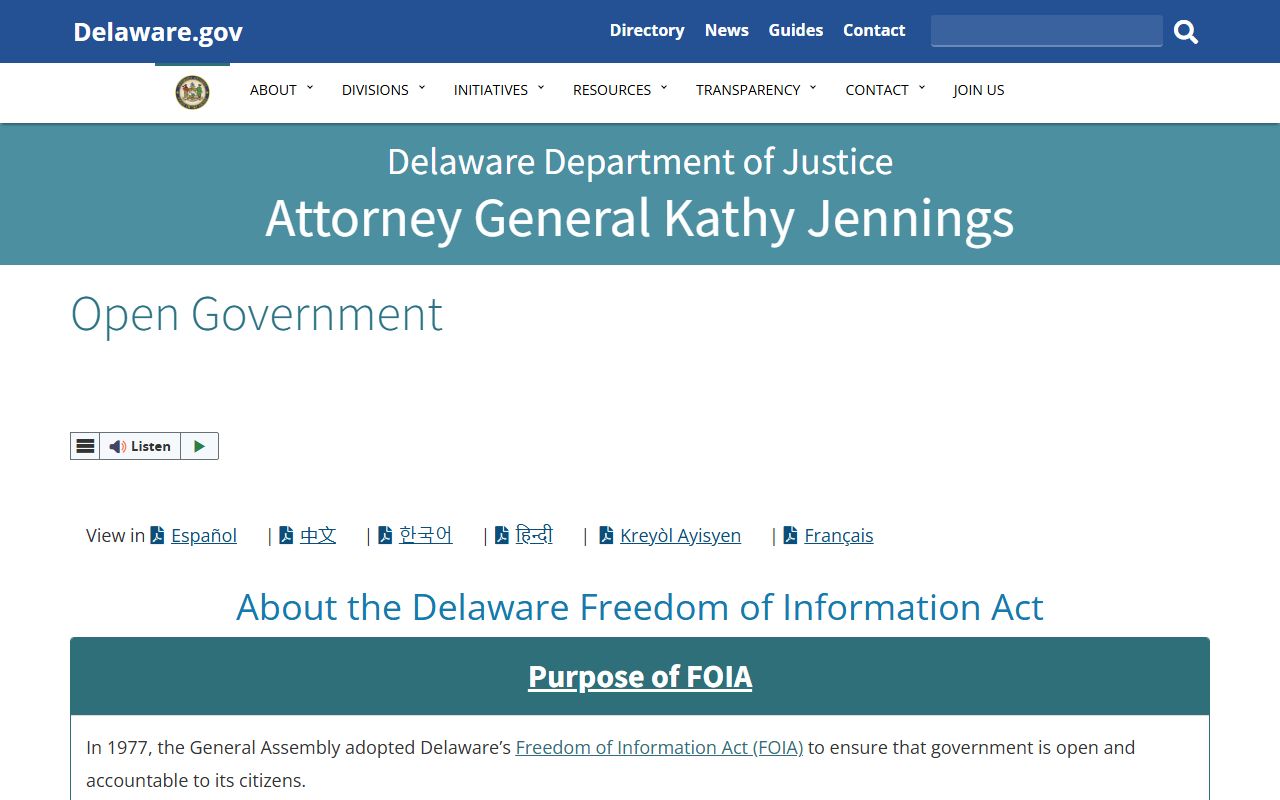
The open government page lays out the full FOIA process. It links to the statute, the petition form, and a list of recent opinions.
The AG opinions page is a rich archive for anyone who wants to study Delaware police records law. Opinion 25-IB29 from May 2025 ruled the DSP did not violate FOIA when it denied body cam and dash cam footage for an open case. Opinion 24-IB01 ruled the DSP did not violate FOIA when it denied officer names, pay, ranks, and past jobs. The opinions give guidance on how to read the law.
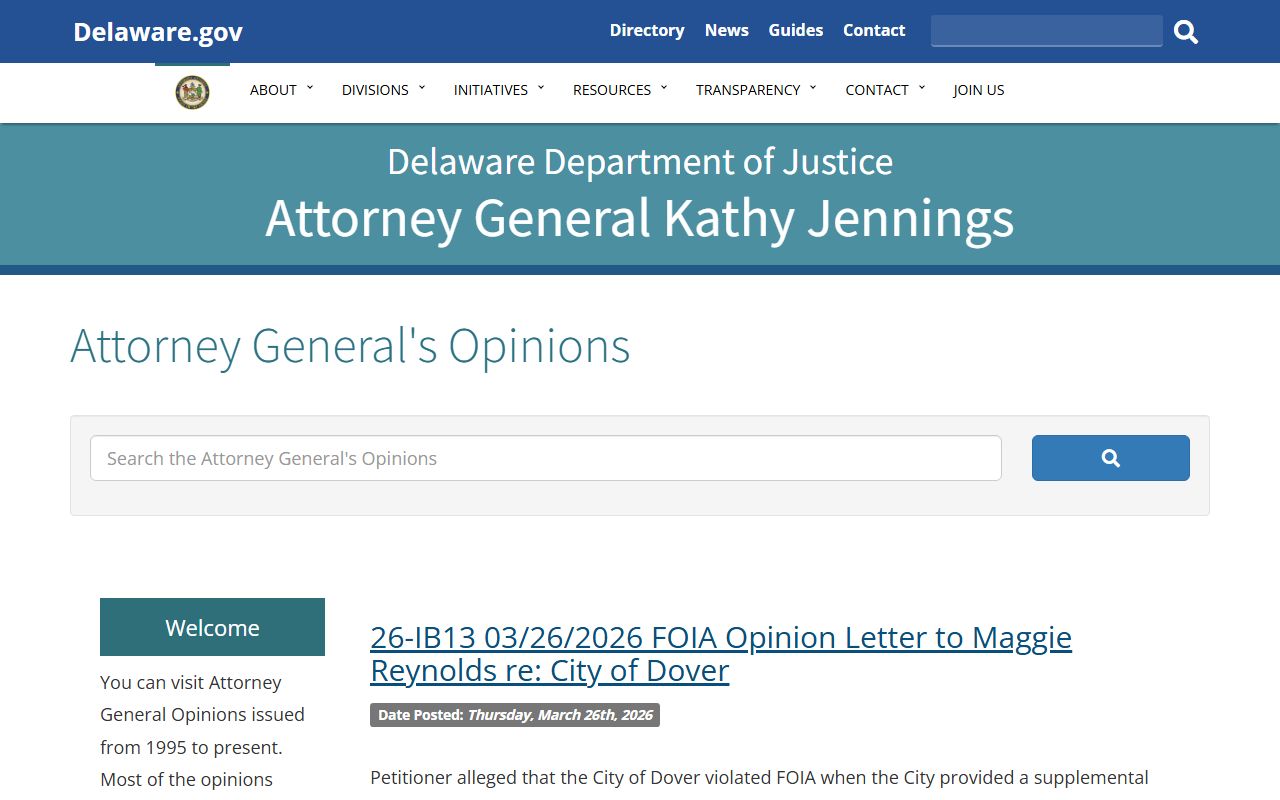
You can browse the opinions by year. Each one shows the facts, the statute at issue, and the AG's ruling. The opinions are a useful guide before you file a petition.
Secretary of State FOIA Requests
The Delaware Department of State also takes FOIA requests. The request must be in writing and must name the records with enough detail for staff to find them. You can send a request through the online form, by PDF over email, by fax, by mail, or in person.
The mail address is Delaware Public Archives, FOIA Coordinator, 121 Martin Luther King Jr. Blvd. N., Dover, DE 19901. The same address works for in-person drop-off. The Department has the same 15 business day window as every other public body under 29 Del. C. § 10003.
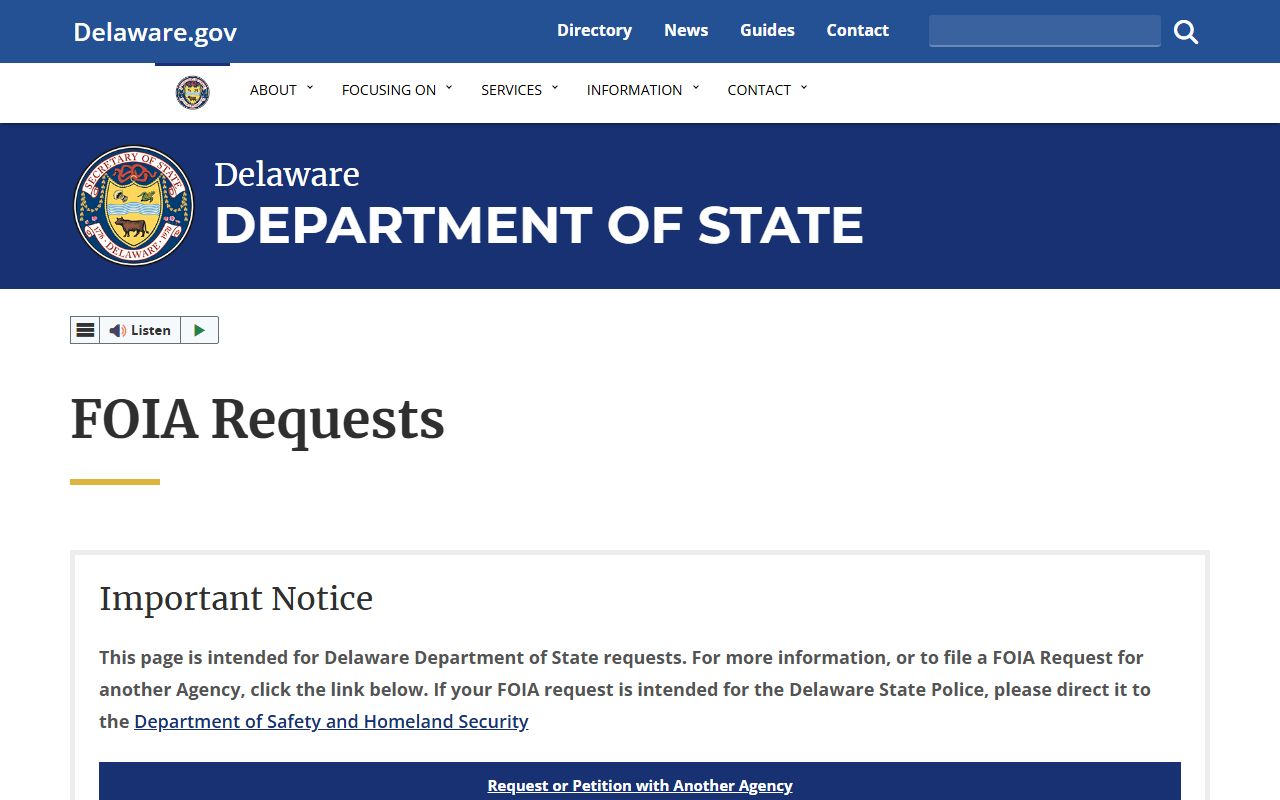
The page walks through what to include in the request and how staff will reply. It is not a police agency, but its FOIA process is a clear model for any Delaware agency.
What Delaware Police Records Contain
Delaware police records cover a wide range of data. The type of file depends on the event and the agency. Most people ask for a crash report, an arrest log, or an incident report. Each file lists the date, the place, the officer, and a short summary of what took place.
A typical Delaware police file may hold:
- Incident or offense report with a case number
- Crash or collision report with a sketch
- Arrest record with name, charge, and booking details
- Witness and victim statements
- Photos and body-worn camera notes
- Computer-aided dispatch logs
- Sex offender registry entries
Some fields are blocked out before release. Social Security numbers, dates of birth, medical data, and victim addresses are often redacted. Juvenile data and open case notes are not released. For a certified criminal history, the request must go to the SBI. Under 29 Del. C. § 10002(o)(3) and (o)(4), files on an open case or a sealed case are exempt from FOIA.
Browse Delaware Police Records by County
Delaware has three counties. Each county has its own police records system. Pick a county below to find the local police, the sheriff, the SBI site, and the court that handles criminal cases in that area.
Major Delaware Cities
Most Delaware cities have their own police department and records unit. Pick a city below for local contact info, the FOIA process, and links to police records in that area.